
Why SMEs Should Not Rush Into AI Without a Cybersecurity Roadmap
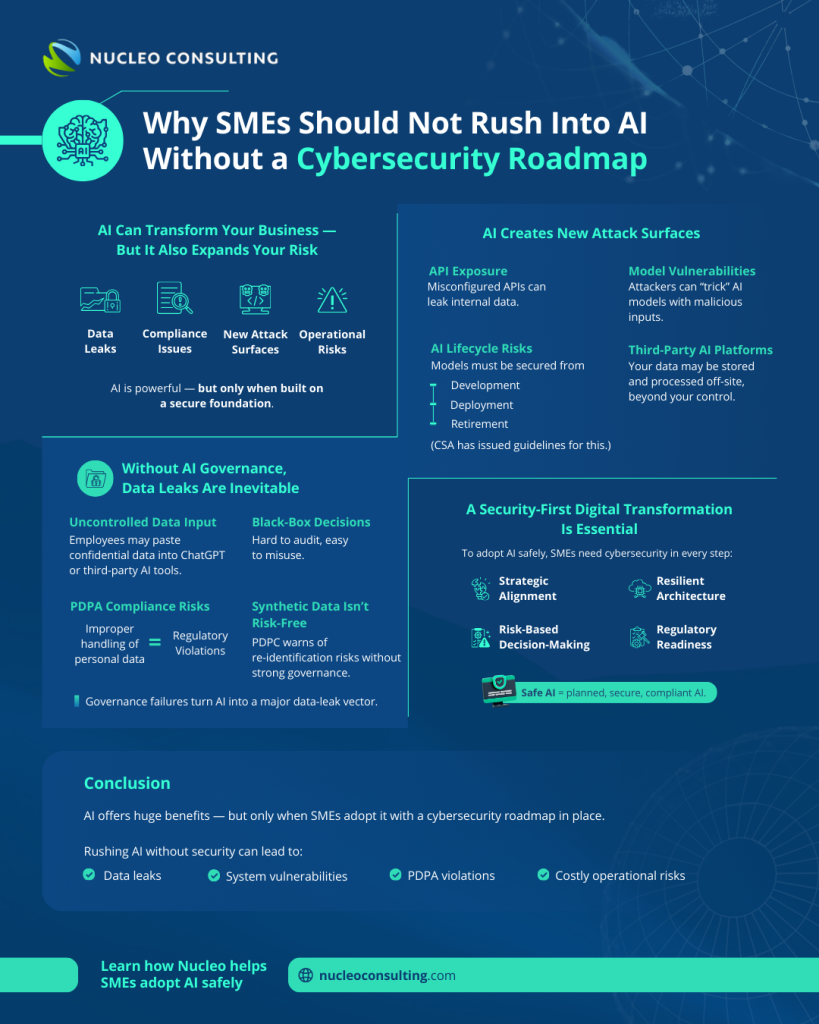
Artificial Intelligence (AI) can transform your business — but if you dive in without a solid security plan, you’re exposing your company to new risks. For SMEs in Singapore, the fast adoption of AI must be balanced with a mature cybersecurity strategy. Without this, you risk data leaks, compliance violations, and uncontrolled attack surfaces.
In this article, we explore why AI is not just an innovation opportunity, but also a cybersecurity risk — and how Nucleo Consulting helps SMEs build the foundational security layer that makes AI both powerful and safe.
1. AI Creates New Attack Surfaces
AI systems expand your risk landscape in ways traditional IT doesn’t. Here’s how:
- API exposure: AI models often communicate over APIs. If misconfigured, attackers could exploit these to access internal data.
- Model vulnerabilities: Adversarial attacks can manipulate AI models (for example, via malicious inputs) and trick them into making unsafe predictions or revealing sensitive data.
- Third-party AI platforms: When you rely on external AI services, your sensitive data may be processed and stored off-site — outside of your own secure perimeter.
- Lifecycle risk: From development to retirement, AI models need to be managed securely. Singapore’s Cyber Security Agency (CSA) has even issued guidelines to help organisations secure AI systems throughout their lifecycle. dataprotectionreport.com
In short: AI is more than just “smart automation.” It’s a potential entry point for cyberattacks — unless you treat it with the same care as your core IT infrastructure.
2. Poor AI Governance Leads to Data Leaks
Without the right governance, AI can become a major data-leak vector:
- Uncontrolled data ingestion: Employees might feed sensitive or personal data into AI tools without considering how that data is stored, shared, or used.
- Lack of transparency: AI decisions powered by “black box” models can be difficult to audit, increasing risk of misuse or error.
- Non-compliance with data regulation: In Singapore, the PDPA (Personal Data Protection Act) applies. If personal or customer data is processed in AI without proper controls, organizations may run afoul of data protection regulations. dataprotectionreport.com
- Synthetic data risks: While synthetic data is an appealing way to train AI (especially under Singapore’s PET Sandbox), the PDPC has highlighted risks of re-identification and the need for strong governance frameworks. Singapore
3. A Security-First Digital Transformation Is Crucial
If you’re digitalising with AI, cybersecurity should be part of every step, not an afterthought. Here’s why:
- Strategic alignment: A cybersecurity-first roadmap ensures that your AI adoption supports business goals and protects mission-critical data.
- Risk-based decision-making: By assessing AI risks early, you can prioritise security investments (e.g., secure AI platforms, model testing, API hardening).
- Resilient architecture: Planning for backup, access controls, and recovery from the start makes your AI deployment more robust.
- Regulatory readiness: A structured roadmap helps you align with Singapore’s AI and data protection frameworks, reducing compliance risk.
This kind of disciplined, secure digital transformation sets your business up for sustainable growth — without sacrificing safety.
4. How Nucleo Provides the Foundation
At Nucleo Consulting, we specialise in building that security foundation. Here’s how we help SMEs adopt AI safely and securely:
- ISO 27001 Lead Auditor–certified engineers design and implement security frameworks for your organisation.
- Our backup solutions safeguard not just traditional data, but also AI-generated content — ensuring you can recover and audit as needed. Check out our offering here: Nucleo Consulting Backup Solutions.
- We help define AI governance policies, set up data access controls, and monitor AI usage.
- Through our IT consultancy and long-term strategy services, we guide you to adopt AI in a way that optimises benefit while managing risk.
With Nucleo as your partner, you don’t just enable AI — you secure it.
5. Real-World Context: Singapore Is Watching AI Closely
- The IMDA and other Singapore agencies are actively developing standards and tools for responsible AI use. Infocomm Media Development Authority
- The PDPC, meanwhile, has published guidance on synthetic data generation, emphasising risk assessments and governance for AI systems. Singapore
- These developments show that Singapore’s regulators are not ignoring AI — they’re guiding its safe adoption.
If you move too fast without laying a security foundation, you risk falling out of step with regulatory expectations.
Conclusion
AI is a powerful tool — but it’s not a silver bullet. For SMEs in Singapore, rushing into AI without a cybersecurity roadmap is risky. You’re inviting data leakage, compliance exposure, and potential system vulnerabilities.
By working with Nucleo Consulting, you can build a security-first foundation for your AI ambitions. From governance to backup and recovery, we help you adopt AI with confidence, control, and long-term resilience.
Related Nucleo Consulting Articles
Here are four relevant articles from Nucleo’s blog:
- Why SMEs in Singapore Need CISO-as-a-Service (CISOaaS) Now More Than Ever — Learn how outsourced leadership can close security gaps cost-effectively. Nucleo Consulting
- The SME’s Guide to Building a Long-Term IT Strategy — Why planning matters more than reactive fixes. Nucleo Consulting
- How is Personal Data Compromised? — Understanding common data risks and how to protect your business. Nucleo Consulting
- NAVI – Nucleo Consulting’s Reliable AI Assistant — Example of a controlled, internal AI implementation. Nucleo Consulting
#AI #CyberSecuritySG #SingaporeSME #AIGovernance #DataProtection #ITStrategy #BackupSolutions #DigitalTransformation #SMERisk #NucleoConsulting