
Shadow AI: The Newest Cybersecurity Threat Inside Your Company
Introduction
With AI tools becoming part of daily workflows, many employees in Singapore are quietly using unapproved AI apps to speed up work. This hidden trend — known as Shadow AI — is rapidly emerging as a serious cybersecurity and compliance risk for organisations.
From accidental data leaks to PDPA violations, Shadow AI can expose a company in ways leaders are often unaware of. This article explains why it matters, how to identify it, and what companies can do to eliminate the risk.

Shadow AI: A Growing Blind Spot in Modern Workplaces
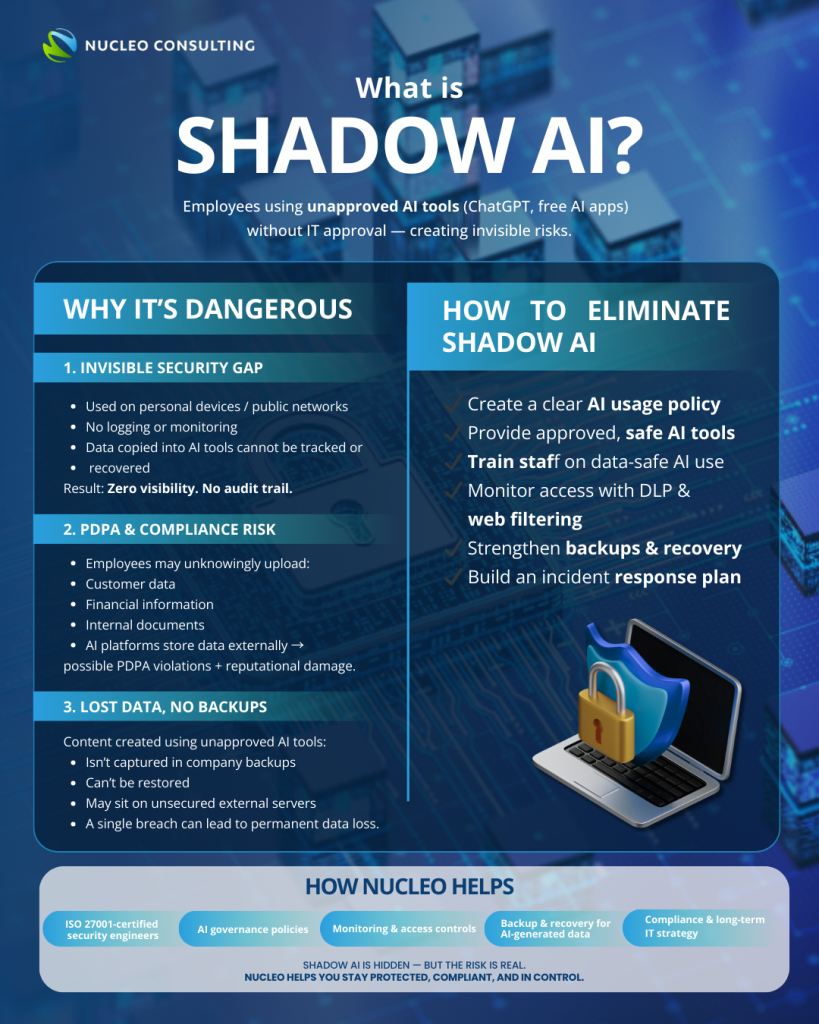
Shadow AI happens when employees use AI tools that are not sanctioned or monitored by the company. Unlike official tools protected by corporate governance, Shadow AI introduces several silent risks:
1. It Creates an Invisible Security Gap
Employees may turn to AI tools on personal devices or non-corporate networks, making it nearly impossible for IT teams to detect the activity.
For example, recent discussions in Singapore newspapers highlighted concerns over staff copying sensitive internal data into free online tools without knowing how these tools store or reuse the information. Although the tools may look harmless, the organisation ends up losing visibility and control.
This lack of visibility also interferes with incident response because data processed outside company systems cannot be tracked, logged, or properly audited.
2. It Increases PDPA and Regulatory Exposure
AI tools often store input data on external servers. This becomes a major problem when employees unknowingly upload:
- Customer information
- Financial data
- Internal documents
- Personal data belonging to Singapore residents
Under PDPA, companies are responsible for protecting the personal data they collect — even if the data leak comes from unapproved tools.
Recent headlines in Singapore have highlighted the risks of third-party leaks and improper vendor data handling, reminding businesses that compliance failures can result in fines, reputational damage, and mandatory reporting.
3. It Causes Data Governance and Backup Inconsistencies
When employees generate content, reports, or analysis using unapproved AI tools, the information does not exist within corporate backup systems.
This means:
- The company cannot perform disaster recovery
- IT teams cannot apply version control
- Sensitive information may exist in uncontrolled environments
If a cyber incident occurs, these AI-generated files could be lost permanently or — worse — recovered by malicious actors who exploit open AI platforms.
Checklist: How to Eliminate Shadow AI in Your Organisation
Below is a practical, immediate-use checklist companies can implement to identify, reduce, and eliminate Shadow AI:
1. Develop a Clear AI Usage Policy
Define approved and prohibited tools, acceptable data types, minimum security requirements, and employee responsibilities. Make AI policy part of onboarding and regular reviews.
2. Provide Safe, Company-Approved AI Tools
When employees lack proper tools, they find their own. By offering secure AI platforms, companies reduce the motivation for Shadow AI.
3. Train Employees on AI Safety
Use real-world local examples to educate teams on:
- PDPA obligations
- Data-sharing risks
- How AI platforms store or reuse data
- What information must never be uploaded
4. Implement Monitoring & Access Controls
Tools such as web filtering, proxy monitoring, and DLP (Data Loss Prevention) help detect unapproved AI usage. IT teams can then intervene early before an incident escalates.
5. Strengthen Backups & Data Recovery
Even with governance in place, human error still occurs.
This is where a robust backup strategy becomes your safety net.
Explore Nucleo’s solutions:
👉https://www.nucleoconsulting.com/backup/
Key benefits of a strong backup strategy include:
- Restoring clean versions of confidential files
- Protecting data previously exposed to Shadow AI
- Ensuring business continuity during incidents
- Creating a verifiable custody trail for compliance
6. Establish a Clear Incident Response Plan
If Shadow AI is detected, IT teams must know:
- Who to notify
- What systems to isolate
- How to review access logs
- How to recover impacted files
- How to report under PDPA guidelin
How Nucleo Consulting Helps Businesses Stay Safe from Shadow AI
Nucleo Consulting’s IT engineers — all ISO 27001 Lead Auditor certified — support organisations across Singapore and Asia in establishing secure AI governance.
Nucleo provides:
- Comprehensive data backup and restoration
- Security monitoring
- Policy development
- Cyber awareness training
- Long-term IT strategy
- Compliance and risk management guidance
Shadow AI may be hidden, but its damage is real — and Nucleo helps companies regain control.
Conclusion
Shadow AI is no longer a minor IT concern — it is a fast-growing cybersecurity, compliance, and operational threat.
With employees adopting AI tools faster than organisations can regulate them, businesses must take proactive steps to close the blind spots.
By combining strong policies, staff training, monitoring tools, and Nucleo Consulting’s enterprise-grade backup solutions, companies can transform AI from a risk into a secure, strategic advantage.
Relevant Internal Backlinks (All Links Verified)
Here are 4 working backlinks to existing Nucleo Consulting articles:
- Understanding Phishing Attacks:
https://www.nucleoconsulting.com/phishing-attacks-how-to-identify-and-protect-your-business/ - Cybersecurity Insurance for SMEs:
https://www.nucleoconsulting.com/cybersecurity-insurance-why-your-business-needs-it/ - Top IT Security Challenges for SMEs in 2024:
https://www.nucleoconsulting.com/top-it-security-challenges-faced-by-smes-in-2024/ - Password Policies and Access Management:
https://www.nucleoconsulting.com/strengthening-password-security-for-your-business/
Each backlink reflects a relevant theme: cyber risk, security gaps, operational resilience, and compliance.
ShadowAI | CyberSecuritySG | AIGovernance | PDPACompliance | SingaporeSME | ITSecurity | DataProtection I NucleoConsulting I BackupSolutions I ITConsulting