
PSG and EDG Are Gone. What’s the New EDGE Grant and What Does It Mean for Singapore SMEs?
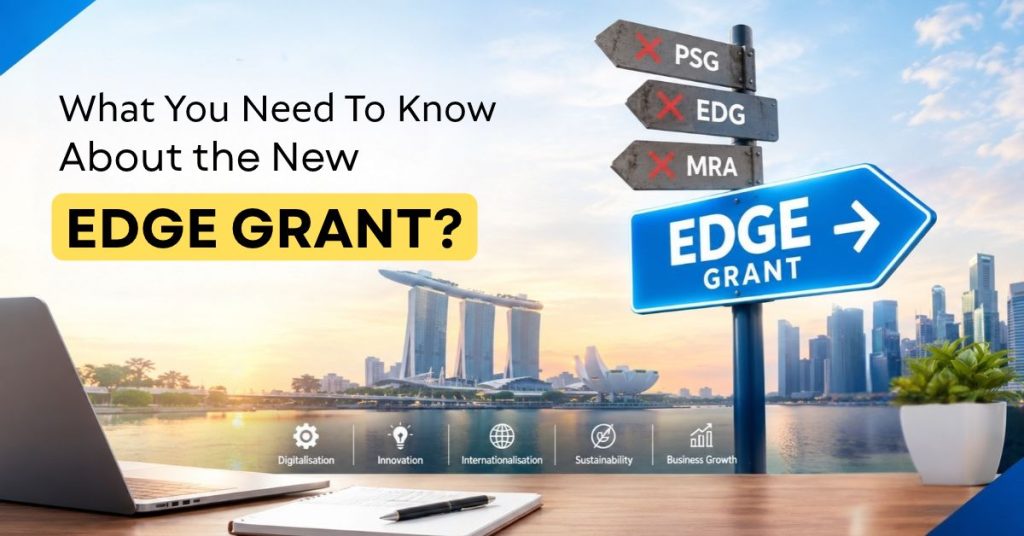
For years, Singapore SMEs have relied on government support schemes such as the Productivity Solutions Grant (PSG), Enterprise Development Grant (EDG), and Market Readiness Assistance (MRA) to adopt technology, strengthen business capabilities and expand into new markets.
That landscape has now changed.
As of 30 September 2026, new applications for PSG, EDG and MRA have ceased, with the new EDGE Grant taking their place. Existing applications and ongoing projects under the previous schemes will continue to be processed under their respective schemes, but businesses starting new projects will now need to look to EDGE for support.
So, what does this change mean for Singapore SMEs?
More importantly, how can businesses make the most of EDGE as they plan their next technology, digitalization and business improvement projects?
From Three Grants to One
The EDGE Grant consolidates support previously provided through EDG, MRA and PSG into a single grant framework.
Rather than navigating separate schemes based on whether a business is purchasing a digital solution, upgrading capabilities or expanding overseas, EDGE brings support together under one programme.
The grant covers eight business areas and more than 150 activities, including Automation & Digitalization, Business Strategy, Financial Management, Innovation, Internationalization, Standards and Sustainability.
The objective is straightforward: help businesses invest in areas that can improve efficiency, strengthen capabilities and support sustainable growth.
For SMEs, this means the conversation around government grants is shifting from:
“Which grant can I apply for?” to “What does my business need to improve, and which EDGE activity supports it?” That is an important change in mindset.
What Happened to PSG, EDG and MRA?
Under the previous system, each grant had a different focus.
- PSG primarily helped local SMEs adopt pre-approved IT solutions and equipment to improve productivity.
- EDG supported projects aimed at upgrading, innovating and transforming businesses, including projects involving consultancy, software, equipment, and other qualifying costs.
- MRA supported Singapore businesses looking to expand into overseas markets.
These schemes are no longer accepting new applications from 30 September 2026 onwards. However, businesses with applications submitted before the transition can continue with their existing projects and claims under the original schemes.
For companies planning a new project, however, EDGE is now the key programme to explore.
How Much Support Can SMEs Receive?
EDGE provides up to 50% funding support for SMEs and up to 30% for non-SMEs, although the actual support level depends on the specific activity. For selected internationalisation and sustainability activities, SMEs can receive up to 70% support, while non-SMEs can receive up to 50% support.
Each company can receive up to S$100,000 in total EDGE grant support per year across eligible activities. The grant caps are refreshed annually, from 1 April to 31 March.
This gives businesses greater flexibility to plan and prioritise their investments across different areas of business improvement, rather than viewing the grant as funding for a single project.
What Does EDGE Mean for IT and Cybersecurity?
This is where the change becomes particularly relevant for businesses reviewing their technology infrastructure.
Digitalization is no longer simply about adopting new software. As businesses become increasingly dependent on cloud applications, Microsoft 365, remote access, connected devices and digital workflows, cybersecurity has become an essential part of business resilience.
An SME planning a digital transformation project should therefore consider not only:
“What technology do we need?” but also: “How do we secure it?”
Depending on the relevant EDGE activity and its requirements, businesses may explore improvements around digitalization, systems, business processes and technology capabilities.
For example, companies may want to assess whether they need to:
- Strengthen their network and firewall protection
- Improve endpoint and ransomware protection
- Implement better patch management
- Secure Microsoft 365 and other cloud services
- Strengthen email security against phishing and spoofing
- Improve backup and recovery capabilities
- Enhance IT monitoring and visibility
- Establish stronger cybersecurity policies and processes
- Improve employee cybersecurity awareness
- Prepare an incident response and business continuity plan
Not every cybersecurity product or service is automatically eligible for EDGE support. Eligibility depends on the specific activity, scope, costs and requirements, so businesses should verify the relevant EDGE activity before committing to a project.
EDGE Pre-Approved Solutions with Nucleo
For Singapore SMEs looking to strengthen their IT infrastructure and cybersecurity, Nucleo Consulting offers two EDGE pre-approved solutions designed to address two critical areas of business protection: network security and data backup.
1. Check Point SMB Security Suite – Strengthen Your Network Security
A strong network security foundation is essential as businesses become increasingly connected and dependent on cloud applications, remote access and digital operations. Nucleo’s Check Point SMB Security Suite provides an all-in-one approach to protecting your network, data and devices.
The solution includes a Next-Generation Firewall designed to help block threats such as hackers, phishing and ransomware in real time. It also provides centralized management and visibility, allowing businesses to monitor their security environment through reports and analytics without having to manage multiple disconnected security tools.
2. NuBackup for SaaS Email and Storage – Protect Your Business Data
While cloud platforms such as Microsoft 365 and Google Workspace provide convenient access to business data, organisations should not assume that their cloud data is automatically protected against every form of data loss.
NuBackup for SaaS Email and Storage provides automated and continuous backup for SaaS applications, helping businesses protect important emails and files against accidental deletion, malicious deletion, ransomware and other forms of cloud data loss. It supports backup and recovery for platforms including Microsoft 365 and Google Workspace.
As part of the new EDGE Grant, eligible businesses can explore these solutions for their digitalization and cybersecurity improvements, subject to the relevant grant activity, eligibility and approval requirements.
Do not Start Your Project Too Early
One of the most important things SMEs need to understand about EDGE is when to apply.
Businesses should not start work or make payment or a deposit to a supplier, vendor or third party before submitting their application. Such applications are considered retrospective and will not be supported.
Businesses can purchase a solution after submitting an application but before receiving approval, although they do so at their own risk because submission does not guarantee approval.
EDGE is also administered on a reimbursement basis. Businesses must complete the approved project, fulfil the required deliverables and pay the eligible expenses before submitting a claim.
For SMEs planning a technology upgrade, this makes early planning particularly important.
What Should SMEs Do Now?
The introduction of EDGE is a good opportunity to step back and review your business technology roadmap.
Instead of waiting until a firewall reaches end-of-life, an employee falls victim to phishing or a ransomware incident disrupts operations; businesses can take a more proactive approach.
Start by asking:
1. Where are our biggest technology gaps?
Review your existing hardware, software, network, cloud services and IT processes.
2. Where are our biggest cybersecurity risks?
Look at endpoint protection, email security, passwords and MFA, backups, patching, firewall protection and employee awareness.
3. What business processes could be improved?
Identify repetitive manual processes, outdated systems and areas where digitalization could improve productivity.
4. Which improvements should happen first?
Prioritize projects based on business impact, risk and urgency rather than simply choosing technology because funding is available.
5. Does the proposed project meet the relevant EDGE requirements?
Check the specific activity, supportable costs, vendor requirements, project duration and deliverables before committing.
EDGE Is More Than a Grant Change
The transition from PSG, EDG and MRA to EDGE is more than a change in grant names.
It encourages businesses to look at their needs more holistically, from digitalization and operational efficiency to business resilience, innovation and growth.
For SMEs, this can be an opportunity to finally address technology and cybersecurity improvements that may have been postponed due to budget constraints.
The key is not to start with the grant.
Start with the business problem.
Identify what needs to be improved, determine the right technology or capability, and then assess whether the relevant EDGE activity can support that investment.
Because the ultimate goal isn’t simply to receive funding.
It is to build a business that is more secure, more efficient and better prepared for what comes next.
Wrap Up: Planning an IT or cybersecurity upgrade?
At Nucleo Consulting, we help Singapore SMEs assess their IT and cybersecurity requirements, identify areas for improvement and explore relevant government funding opportunities.
Whether you are looking to strengthen your firewall or enhance your cloud backup and data protection, our team can help you identify the right solution for your business needs and explore available EDGE Grant support to make your investment more cost-effective.