
ChatGPT at Work: Risks, Policies, and Best Practices
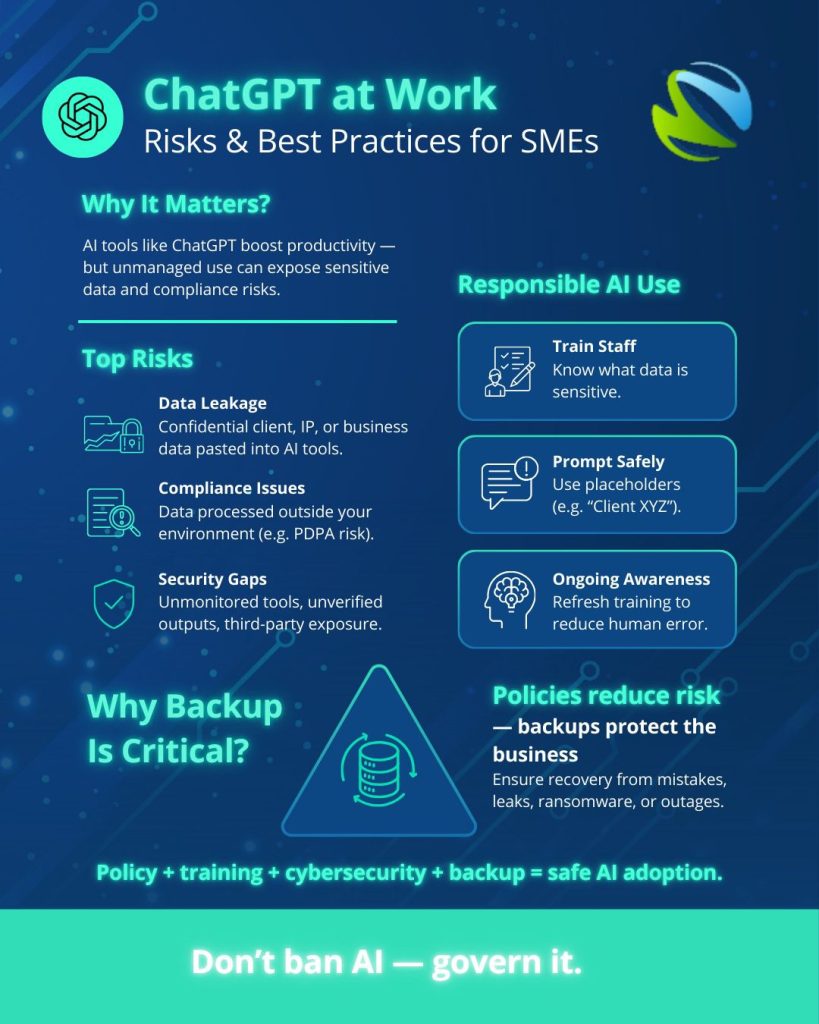
In today’s digital workplace, tools powered by generative AI like ChatGPT are rapidly becoming part of everyday workflows. From drafting emails to summarising reports, organisations are enjoying increased efficiency. But this convenience comes with risk: allowing free-for-all use of AI tools can expose sensitive company data and create unexpected security and compliance gaps if not managed properly.

Why Unrestricted Use of AI Tools Can Expose Sensitive Data
One of the biggest risks with unfettered AI tool usage is data leakage. When employees paste confidential client details, IP, or internal strategies into an external AI prompt, that information may be processed and stored outside your controlled environment. Potentially violating data protection regulations like Singapore’s PDPA and exposing your business to compliance penalties.
Moreover, without clear governance:
- AI tools can become unmanaged attack surfaces,
- Sensitive insights might be inadvertently shared with third-party systems,
- And decisions that impact operations or security may be driven by inconsistent or unvetted AI responses.
This issue is especially significant for SMEs that depend on trust and data integrity for growth.
What a Responsible AI Usage Policy Looks Like for SMEs
Instead of banning AI entirely which can stifle productivity, forward thinking organisations establish responsible AI usage policies that balance innovation with risk control. Key elements include:
- Defined Scope of Use
Set boundaries on what kind of data can be inputted into AI systems. Prohibit inputting confidential project details, client info, or proprietary code unless processed through controlled, internal AI deployments.
- Data Classification and Handling
Tie the AI use policy into your existing data classification framework. For example, treat sensitive or regulated information differently from public or internal only content.
- Integration with IT and Cybersecurity Strategy
AI tools should be considered part of your broader IT governance framework. Aligned with cybersecurity policy, vendor risk management, and data protection standards like ISO 27001.
To learn how a robust IT strategy benefits SMEs beyond AI governance, explore “The SME’s Guide to Building a Long Term IT Strategy.”
- Monitoring & Auditability
Log and monitor AI interactions, especially in regulated environments. Coupled with incident response plans, this supports accountability and quick remediation. Keep in mind that AI governance doesn’t exist in isolation. It should be part of a broader cyber hygiene and training program to reinforce secure practices across your workforce.
For insights on typical organisational risks and how data is compromised, see “How is Personal Data Compromised?”
Employee Training Essentials to Prevent Data Leakage via Prompts
People are often the weakest link in cybersecurity and AI tools can amplify this risk if employees aren’t trained well. Effective employee training should cover:
- Recognising Sensitive Information
Help staff understand what qualifies as sensitive (customer data, contracts, strategies, credentials) and what should never be entered into public AI systems.
- Safe Prompting Practices
Teach safe techniques like replacing real values with placeholders (e.g., “Client XYZ”), and emphasise when to escalate queries to internal subject matter experts instead of using generative AI.
- Regular Refreshers and Phishing Awareness
Because cyber threats are constantly evolving, continuous learning is crucial. Combining awareness with policy enforcement creates a culture of accountability vital for minimising data exposure through AI tools.
Why Backup (& Good IT Strategy) Matters
Even with strong policies and training, data risks can’t be fully eliminated. That’s where a reliable backup strategy becomes indispensable. Backup isn’t just about file restores. It’s about business continuity, compliance, and resilience in the face of human error, ransomware, or system outages.
Nucleo Consulting offers tailored backup solutions designed to protect your critical systems, including:
- NuBackup for Servers — ensuring mission-critical data is continually backed up with minimal downtime.
- NuBackup for SaaS (365 & Google Workspace) — safeguarding email, calendars, and collaboration tools.
- NuCloud Offsite Storage — encrypted copies stored offsite for disaster recovery peace of mind.
- Colocation Services — secure Tier-3 data centre hosting for compliance focused backups.
These layered solutions help protect your organisation not only from external cyber threats, but also from internal mishaps like accidental leaks via AI prompts.
To dive deeper into how backup protects your business beyond AI concerns, check out “Future-Proof Your Business: Why Investing in Nucleo Consulting’s Backup Solutions Are Essential for Long-Term Success.”
Another useful resource is “5 Tech Mistakes That Are Costing You More Than You Think — And How to Fix Them,” which emphasises the strategic value of backups as a core IT component.
Balance Innovation with Safety
AI tools like ChatGPT can unlock productivity gains, creativity, and operational support but only when balanced with strong governance, training, and infrastructure. Rather than burying your head in the sand with a prohibition, SMEs should:
- Adopt a clear policy that classifies acceptable AI use,
- Train employees to use AI responsibly,
- Integrate AI governance with existing cybersecurity strategy, and
- Ensure robust backup systems support data integrity and business continuity.
By doing so, organisations can enjoy the benefits of AI without sacrificing security or compliance and partner with experts like Nucleo Consulting to build a strategy that’s both innovative and resilient.
AIatWork | ChatGPTPolicy | SMECyberSecurity | DataProtection I ITStrategy | BackupSolutions | CyberSafetySG | NucleoConsulting I SingaporeSME