
Why ‘Banning ChatGPT’ at Work Doesn’t Work (and What to Do Instead)
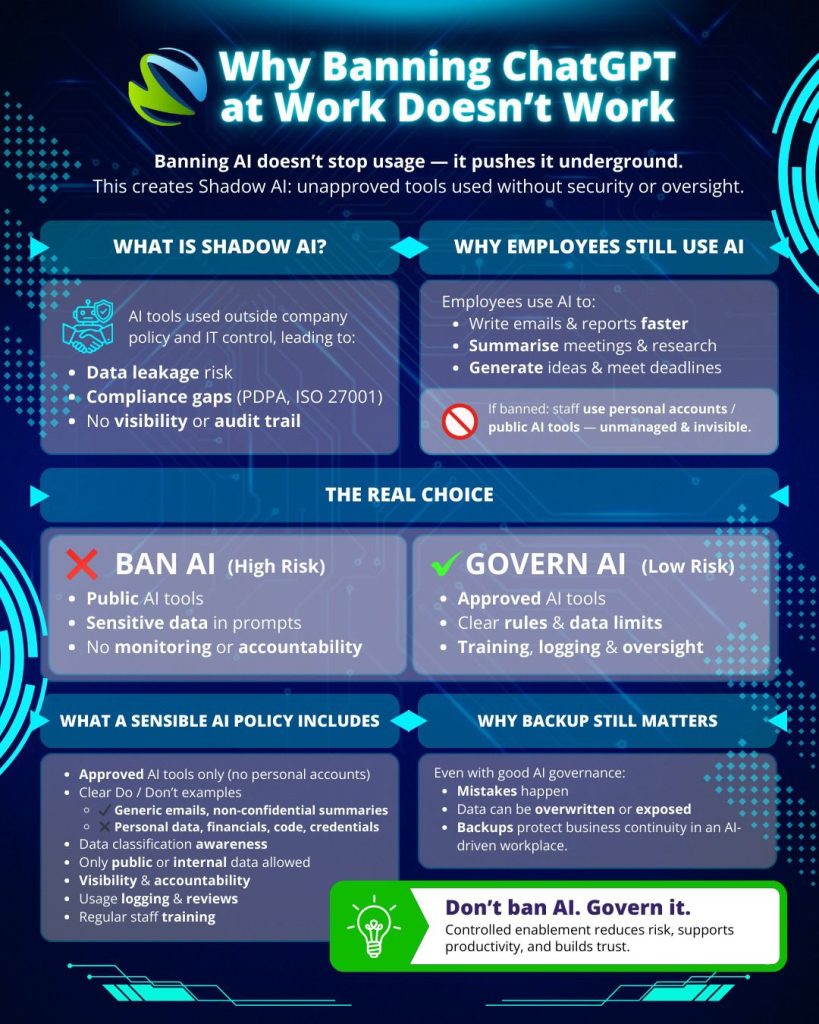
As generative AI tools like ChatGPT become increasingly accessible, many organisations have responded with a simple solution: ban them outright. While this approach may appear to reduce risk, it often creates a bigger problem, Shadow AI.
When AI tools are prohibited without offering secure alternatives, employees don’t stop using them. They simply use them unofficially, outside of IT’s visibility or control. This lack of oversight can significantly increase the risk of data leakage, compliance breaches, and operational blind spots. For SMEs in Singapore, the goal shouldn’t be prohibition but controlled enablement.
Why Staff Will Still Use AI Tools (Even If You Ban Them)
AI tools are now deeply embedded in modern work habits. Employees use them to:
- Draft emails and reports faster
- Summarise meeting notes or research
- Generate ideas, outlines, or simple code
- Meet productivity demands under tight deadlines
When these tools are banned, staff often turn to personal accounts, unapproved browser extensions, or consumer grade AI platforms none of which are monitored or governed by the organisation.
This behaviour reflects many real world cases of how personal data is compromised not through malicious intent, but through convenience driven decisions. Without visibility, IT teams cannot assess what data is being shared, retained, or processed externally.
This is how Shadow AI emerges from AI usage that exists completely outside company policy, cybersecurity controls, and audit trails.
Controlled Enablement vs Unmanaged AI Usage
Understanding the difference between these two approaches is critical for organisations navigating AI adoption.
Unmanaged AI Usage (High Risk)
- Employees use public AI tools independently
- Sensitive or regulated data may be copied into prompts
- No logging, monitoring, or accountability
- No alignment with PDPA or ISO 27001 principles
- Increased exposure to data leakage and compliance risks
Controlled Enablement (Lower Risk, Higher Trust)
- Approved AI tools aligned with business needs
- Clear usage policies and data boundaries
- Employee training on safe prompting practices
- Logging and oversight integrated into IT governance
- AI usage aligned with cybersecurity and compliance strategies
For SMEs, AI governance should not exist in isolation. It should form part of a long term IT strategy for SMEs ensuring innovation supports business resilience rather than introducing unmanaged risk.
What a Sensible AI Policy Actually Looks Like (Checklist)
A practical AI policy does not need to be complex. But it must be clear, enforceable, and understood.
- Approved Tools List
Define which AI tools are permitted for work use.
For example:
- Approved: Enterprise grade AI tools with clear data handling policies
- Not approved: Personal AI accounts used for work related content
This removes ambiguity and reduces the likelihood of Shadow AI adoption.
- Clear Do / Don’t Examples
Employees respond better to real world examples than vague rules.
Do:
- Use AI to rewrite generic emails
- Summarise non confidential documents
- Generate outlines using anonymised information
Don’t:
- Paste customer personal data into prompts
- Share internal financials or legal documents
- Upload proprietary code or system credentials
Clear examples significantly reduce accidental data exposure.
- Data Classification Awareness
AI usage must align with existing data classification frameworks.
Employees should clearly understand what constitutes:
- Public data
- Internal use data
- Confidential or regulated data
Anything beyond “internal” should generally never be entered into external AI tools.
- Logging, Monitoring, and Accountability
AI usage should not be invisible.
A sensible AI policy includes:
- Centralised access where possible
- Usage logging and periodic reviews
- Clear accountability and escalation paths
This supports audit readiness, compliance requirements, and faster incident response.
- Training and Regular Refreshers
AI risks evolve rapidly. Ongoing education ensures employees remain aware of emerging threats and safe practices. Strong cyber hygiene for employees reduces the likelihood of accidental data leakage through AI prompts and discourages unsafe workarounds.Why Backup Still Matters in an AI Enabled Workplace
Even with strong policies and training, mistakes still happen. Files may be overwritten, data may be exposed unintentionally, or systems may be disrupted by ransomware or human error.
This is why organisations must future proof their business with reliable backups.
Nucleo Consulting’s backup solutions are designed to support modern, AI-enabled workplaces by ensuring data resilience and business continuity:
- NuBackup for Servers — protecting mission-critical workloads
- NuBackup for Microsoft 365 & Google Workspace — safeguarding emails, files, and collaboration data
- NuCloud Offsite Backup — encrypted, offsite storage for disaster recovery
- Colocation Services — secure, compliant data centre environments
Learn more about Nucleo Consulting’s backup solutions here:
👉 https://www.nucleoconsulting.com/backup/
In an environment where AI accelerates both productivity and risk, backup solutions provide a vital safety net.
Conclusion: Don’t Ban AI, Govern It
Banning ChatGPT and other AI tools may feel like the safest response, but it often results in greater risk through Shadow AI. A smarter approach is to acknowledge reality: AI is already part of the workplace.
By implementing controlled enablement, clear AI usage policies, employee training, and robust backup solutions, SMEs can embrace innovation without compromising security, compliance, or trust.
With the right IT strategy and expert support from Nucleo Consulting organisations can confidently move forward in an AI-driven workplace while staying protected.
ShadowAI | ChatGPTAtWork | AIPolicy | CyberSecuritySG I SMEIT | DataProtection | BackupSolutions | NucleoConsulting I ITGovernance